The Re-enactment of St Columba’s 563 AD Voyage from Ireland to Scotland

In 563 AD, Columba made a sea voyage from Ireland to Scotland, where he founded a monastery that became a centre of the Christian world for hundreds of years. St Columba is still celebrated today. More than 130,000 pilgrims visit the site of his landing on the island of Iona off Scotland’s west coast each year.
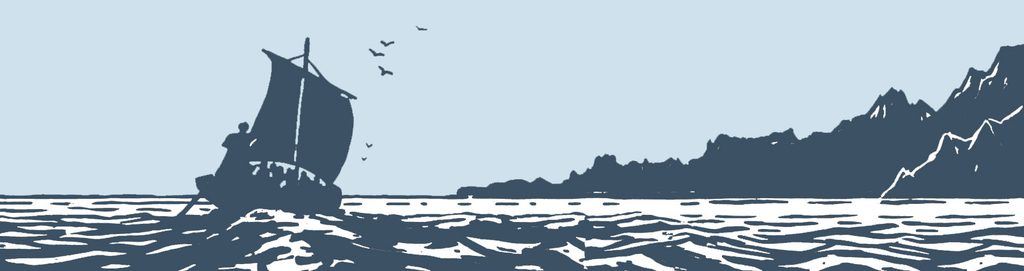
Re-enacting Columba’s voyage in June 1963, fourteen hundred years later, thirteen Irishmen rowed and sailed a traditional open Irish curragh made of light wooden ribs and lathes, with a tar-coated calico skin, from Derry, Northern Ireland, to Iona.
It wasn’t a great distance. One hundred and thirty-eight miles, but nevertheless challenging for the thirteen men aboard this lightweight, flexible boat. Exposed to the open North Atlantic, they had prepared and trained for every eventuality.
Eight unforgettable days after leaving Derry, they ran the curragh up onto the beach of Martyrs Bay, Iona. The passage, like Columba’s, had been spiritually far greater than the mere miles or days.
The idea for the re-enactment to celebrate the 1400-year anniversary of Columba’s voyage had emerged in 1959 in a coffee shop in Belfast. It was in idle chat among churchmen, with much merriment. It came from one Canon John Barry, of the Church of Ireland, known for his sometimes outspoken views in his monthly column in the Church of Ireland Gazette.

To re-enact Columba’s voyage was an outrageous idea for re-enactment voyages were almost unheard of in those days.
But the idea grew into a grand adventure of faith and fraternity. Barry, a participant throughout, subsequently wrote the story of the whole project: the design and building of the curragh, finding a skilled skipper and crew, the planning and training around the coast of Northern Ireland, securing the funding, and then the voyage itself.
Barry wrote in a self-deprecating way, claiming expertise in nothing. For him, the heroes were the skipper, the designer, the boat builder, the other crew members and the curragh, but beneath his commentary, his own engaging and passionate influence shone.
Also included in the book was an Introduction about Columba. and why he left Ireland. This was written by Canon Stephen Cave, a member of the 1963 curragh crew. There was also an Appendix about the curragh, written by Wallace Clark, the skipper of the 1963 curragh. In this, he reflects on the decision to choose a curragh, her design, building and sailing performance, together with his thoughts on how she might have been improved with hindsight.
The book also contained a drawing of the curragh and a list of all the gear carried.
The book, Joyful Pilgrimage, was published in Ireland in 1964, proved popular, and soon sold out.
However, a facsimile edition was published in 2025, and an audiobook in 2026. Read more…

About the author, Canon John Barry
Born in Belfast in 1915, John Barry was fascinated from his early years by the Barry family story. They were Protestants forced to flee north Italy then south-east France to escape religious persecution in the early 16th century. They arrived in Ireland in the early years of the 17th century.
The Iona Curragh became the key moment in his ministry, of greater significance to him in his life than the 34-year incumbency of the Parish of Hillsborough in Co Down, Chaplain in that time to every Governor who represented the Sovereign in N Ireland.
Following the voyage, John continued as the Chaplain to the curragh crew for the rest of his life, never ceasing to care for each of them and their families.
Canon John Barry retired after 45 years in 1983 and died on the Eve of St Matthew’s Day 2006 at the age of 91.
But that’s not the end of the story. Read more…
